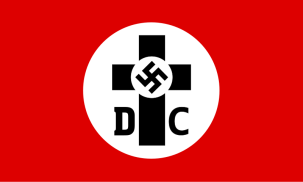
How does one go about judging a religion when a radical faction uses an extreme interpretation of doctrine to commit atrocities? I speak of course about the Deutsche Christen – the fanatical Nazis who saw the Christian faith, antisemitism and the cause of the Third Reich as one and the same.
The theologians of the Deutsche Christen movement linked together the Protestant tradition (including Martin Luther’s many anti-Semitic remarks) with Nazi theories of Volk and race. They sought the “de-Judaization of the church” and the elevation of their version of an “Aryan Jesus.” Rather than some fringe movement during the Third Reich, the Deutsche Christen numbered 600,000 at its peak including senior members of the Church hierarchy, religious scholars and the laity.
The movement’s Institute for the Study and Eradication of the Jewish Influence on the German Church “redefined Christianity as a Germanic religion whose founder, Jesus, was no Jew but rather had fought valiantly to destroy Judaism, falling victim to that struggle. Germans were now called upon to be the victors in Jesus’s own struggle against the Jews, who were said to be seeking Germany’s destruction.”
For the Deutsche Christen, the cause of Nazism was the logical end point of protestant theology. As Erich Koch, Reichsminister for Ukraine would tell his post-war prosecutors:

When Hitler rose to power Koch had been both Gauleiter of East Prussia and president of his provincial Church Synod. He was a respected leading figure both for the Nazi cause and within the Protestant Church.
Committed Christians could also be found at the front line in the worst atrocities of the war and the implementation of the Final Solution. Ernst Biberstein, a student of theology who worked as a pastor through the years of the Weimar Republic, went on to serve as an Obersturmbannführer in the SS. As the leader of Einsatzkommando 6, he was later charged with responsibility for the execution of more than 2,000 people. He personally oversaw the execution of more than fifty victims who were shot to death in a mass grave.
Rather than the race hatred of the Deutsche Christen, it is their opponents who are today best remembered as representative of Christianity during the Third Reich. The opposition of figures from the Confessing Church such as Dietrich Bonhöffer, Martin Niemöller and Karl Barth is held up as evidence of Christianity’s inherent revulsion towards National Socialism.
While these individuals did oppose Nazi policies, in some cases with fatal consequences, the Confessing Church was primarily concerned with the Nazification of German Protestantism and the Deutsche Christen’s efforts to elevate race to central organizing principles of the church.
Martin Niemöller is today remembered for his denunciation of German cowardice in the face of state oppression:
First they came for the Socialists, and I did not speak out—
Because I was not a Socialist.
Then they came for the Trade Unionists, and I did not speak out—
Because I was not a Trade Unionist.
Then they came for the Jews, and I did not speak out—
Because I was not a Jew.
Then they came for me—and there was no one left to speak for me.
The irony of this paean to solidarity is that Niemöller was himself an enthusiastic supporter of the Nazis when they rose to power in 1933.
So what relevance does this group of Nazis hold for the larger meaning of Christianity. The Deutsche Christen are usually described not just as aberrant to the Christian religion, but definitionally outside of its boundaries. As Doris Bergen has argued:
In the case of Christianity, the radical reimagining of the Christian faith for the purposes of supporting mass atrocities and genocide is not today held against all co-religionists. While some extremists looked to the Christian scriptures and saw a legitimization of racial hierarchy, expansionist warfare and genocide, others used the same holy texts to resist Nazism and the Holocaust. We privilege the latter as the norm, and dismiss the former as an exception.
When one is tempted to define a religion by the worst actions of those who claim to follow its tenets, it is worth remembering the case of Pastor Biberstein, saying his morning prayers on the Eastern Front before he set out on another day of bloodshed and murder. Who is to blame for him and his Aryan Jesus? If we can deem him a radical outlier of Christianity, why is it not same when applied to other religions, to other atrocities?


 Ned Richardson-Little
Leave a comment